
Lithium Batteries

Moving Items with Lithium Batteries
What Customers Need to Know
Many everyday household items contain lithium batteries. Lithium batteries are classified as Dangerous Goods under the Australian Dangerous Goods Code because they can present a fire risk if damaged, crushed, overheated or packed incorrectly.
Many lithium battery powered items can be moved safely during a household relocation, however customers must follow a few simple safety rules.
Important – Lithium Battery Restrictions
Under the removalist's terms and conditions, lithium-ion batteries with a Watt-hour (Wh) rating exceeding 100Wh cannot be transported or stored. This restriction applies to both batteries installed in equipment and loose or spare batteries.
Customers are responsible for identifying lithium-ion batteries in their belongings, checking their Wh rating and advising their removalist of any relevant items before moving day.
Customers will also be required to complete a Lithium Battery Declaration confirming that the goods presented for transport or storage do not include lithium-ion batteries exceeding 100Wh.
Providing false or misleading information about lithium-ion batteries may create serious safety risks and could adversely affect or invalidate insurance coverage.
AFRA Lithium Battery Calculator
Check the watt-hour (Wh) rating of a lithium-ion battery before your move.
How to use the calculator
Find the battery rating on its label, then select the matching information in the calculator.
- Choose whether the label shows Wh, or voltage (V) together with capacity (Ah or mAh).
- Enter the figures exactly as printed on the battery label.
- Read the watt-hour result and the safety requirements.
- Select “Check Another Battery” to check the next battery.
If you cannot identify the battery rating, ask your removalist before packing.
Where do I find these numbers?
Check the battery label or manufacturer's specifications for Wh, V, Ah or mAh. For example, 18V × 5Ah = 90Wh; 3.7V × 20,000mAh ÷ 1,000 = 74Wh. Use the rated/nominal battery voltage, not the charger's output voltage.
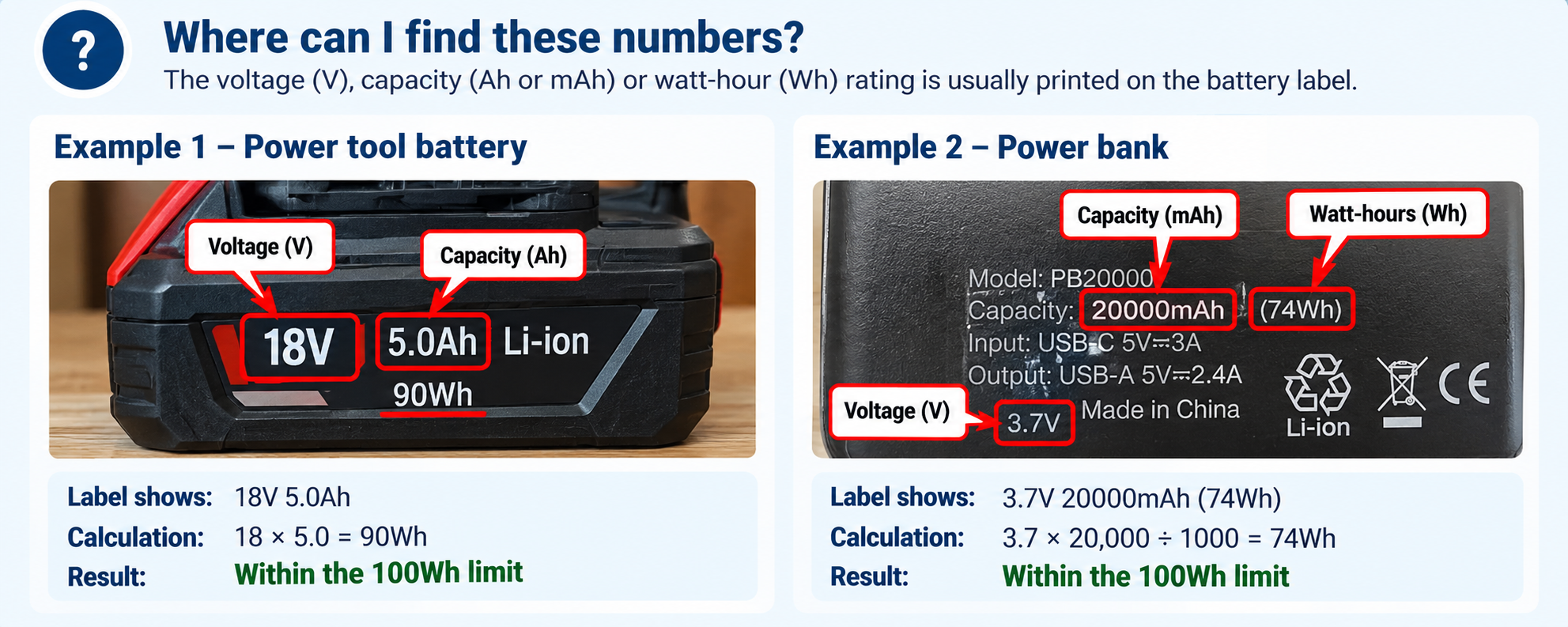
Illustrative labels only — your battery may look different. Use the rating printed on your actual battery.
If you cannot determine the battery rating, contact your removalist before packing.
Important safety requirements
- Damaged, swollen, leaking, overheating, defective or recalled batteries must not be transported.
- Switch devices off and protect them from damage or crushing.
- Keep batteries installed in equipment where possible.
- Declare all loose or spare batteries before moving day. Do not pack them in household cartons; keep them separate and protect terminals from short circuits.
- Follow your removalist's instructions and complete any required lithium battery declaration.
Meeting the 100Wh capacity limit does not by itself authorise transport or storage. This tool applies the capacity threshold in AFRA's customer guidance; your removalist must assess all other requirements.